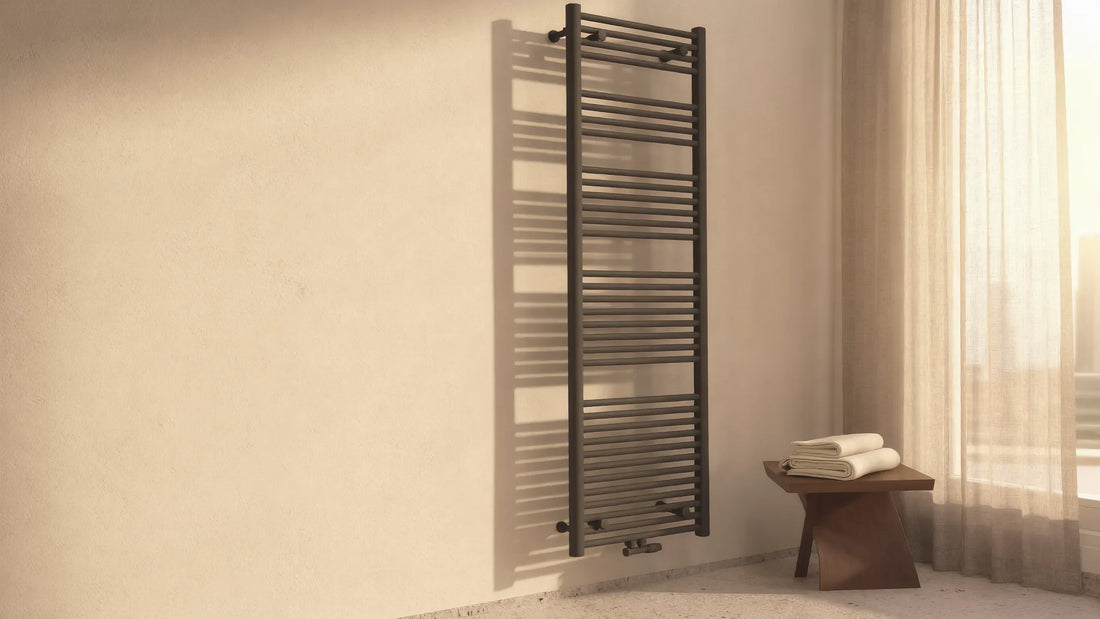
Valve radiator or compact radiator: connect from below or from the side?
Flat panel radiators can be connected from underneath or from the side. How valve and compact radiators differ and which connection to the pipes in your wall is right for you.

In short: Valve radiators and compact radiators differ mainly in their connection. The valve radiator is connected from below and has the thermostatic valve built in, while the compact radiator is connected from the side, with the valve on the outside. If your pipes come out close together from below, the valve radiator is suitable; if they come out of the wall on the side, above and below, choose the side connection.
At the end of September, when the first radiators are switched on again, some people notice that one is too small or too old. A look at the shop reveals two terms that sound similar but are designed for different pipe layouts. If you know the difference, you won't order one that doesn't suit your pipes.
Valve radiators and compact radiators: one principle
Valve radiators and compact radiators are both panel radiators. They consist of water-carrying panels with convector fins behind them. The types are also the same: Type 22 has two panels, Type 33 has three. For the same size and design, their heating surface is also comparable.
The difference lies in where the water enters and leaves and where the thermostatic valve is located. On the compact radiator, the connections are on the sides. The thermostatic valve is screwed onto the upper connection on the outside, while a return fitting is added at the bottom. On the valve radiator, the valve has moved inside the radiator as an insert, and the connection is made from below.
| Feature | Valve radiator | Compact radiator |
|---|---|---|
| Connection | from below, close together | from the side, top and bottom |
| Thermostatic valve | built-in | on the outside of the connection |
| Connection | via a valve block | via valve and return fitting |
| Visible pipes | short, below the radiator | at the side next to the radiator |
| typical use | new builds, pipes from the floor or lower wall | existing buildings with side pipes |
Connection from below
Connection from below is now common in new builds. The pipes come out close together from the floor or just above the floor from the wall. A valve block connects them to the radiator. The result is tidy: a compact component sits below the radiator, and no pipe is visible on the side.
On the KONRAD Type 22 valve radiator, the two connections at the bottom are 50 mm apart, and it can be connected from below on the right or left. How the built-in valve insert works and what the valve block does is explained in the article Connecting valve radiators from below.
When connecting from below, also consider ease of use. The thermostat head sits on the side where the valve is built in. If a cabinet is placed there later or a curtain hangs in front of it, it will be difficult to reach and will measure a distorted temperature. Therefore, plan the connection side so that the head remains free and easily accessible.
Side connection
With a side connection, the hot water enters at the top on one side and leaves the radiator at the bottom. If both connections are on the same side, it is called same-side connection. This is the classic method in many existing buildings where the pipes come out of the wall on the side next to the radiator.
For long radiators, it can make sense to connect them crosswise: flow at the top on one side, return at the bottom on the other. The water then flows through the entire length, and the radiator heats up more evenly. When this is worthwhile is described in the article Crosswise connection.
For a side connection, the distance between the upper and lower connection is important. For the KONRAD, it is the height minus 55 mm. If your pipe ends do not match this dimension, they must be adapted. Which fittings are required for a side connection is stated in the installation instructions.

The KONRAD can be connected in six ways: twice from below, twice same-side and twice crosswise.
Which method suits your pipes?
In most cases, the decision is not based on taste, but on the position of the pipes. These questions will help you:
- Where do the pipes come out? Close together at the bottom indicates a valve radiator, above each other on the side indicates a side connection.
- How far apart are they? Measure from center to center and compare with the dimension of the new radiator.
- Which side are they on? Left, right, or centered below the planned radiator?
- Are new pipes being laid anyway? Then you can choose the connection freely.
- Which heating system do you have? In a one-pipe heating system, several radiators are connected to one circuit. It requires a different connection than a two-pipe heating system, which the specialist company will clarify.
If you are unsure or want to leave yourself options, a radiator with multiple connection options is practical. The KONRAD offers both methods, and the unused openings are sealed with the included plugs. If the room needs more heat on the same wall area, the KONRAD Type 33 is available in a three-panel design. You can find all models under Living room radiators.
Important: Which connections are flow and return, and which openings are to be sealed, is determined by the heating specialist company according to the installation instructions. Swapped connections lead to poor control and noise.
Frequently Asked Questions
Can I replace an old compact radiator with a valve radiator?
Yes. Either the pipes are moved downwards so that they suit a connection from below, or you use a radiator that can also be connected from the side. The second method usually saves work on the pipes.
Is connection from below more efficient?
For heat output, it is most important that the flow and return are connected correctly and that the radiator is large enough. Connection from below is primarily a question of aesthetics and pipe routing, not performance.
Can you see more pipe with a side connection?
Usually, yes. The pipes come out of the wall next to the radiator and lead to the side connections. If you want it to look tidier, have the pipes routed vertically and close to the radiator and seal the wall penetrations with rosettes.
What does height minus 55 mm mean specifically?
For a KONRAD with a height of 600 mm, the side connections are 545 mm apart, and for a height of 500 mm, 445 mm. Measure your pipe ends from center to center and compare them with this value before choosing the height.
Choose the panel radiator for your pipe layout
Valve radiator with connection from below and side connections, in many heights and widths, as Type 22 and Type 33.